Reana
Church of Santa Maria degli Angeli
15th Century
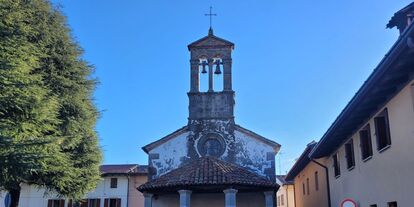
The votive Church of Santa Maria degli Angeli dates back to 1460 and was probably commissioned by the Confraternity of the Madonna della Cintura, which was very active in Reana at that time.
The building has a rectangular single nave and stands at street level; the rectangular apse is smaller in volume.
The façade is preceded by a loggia with a five-pitched wooden roof supported by four stone pillars resting on a high plastered perimeter wall. The gabled façade, with a central rose window, culminates in a tall bell gable with a double opening. The moulded stone portal is set between two rectangular windows with stone frames. The sacristy adjoins the left side of the presbytery with a single-pitched roof.
Restoration works removed the plaster entirely, leaving the roughly squared stone masonry exposed. The corners are reinforced with well-cut stone blocks.
Interior
The interior consists of a single nave. On the right side there is a pointed single-light window in the nave and a rectangular window in the apse; on the left side, a secondary entrance.
The floor is made of terracotta tiles.
The ceiling features an exposed wooden structure with brick infill.
The square presbytery, raised by one step, has a sail vault with ribs. The sacristy is located on the left side of the presbytery.
The interior was once richly decorated with frescoes. Today, the most remarkable surviving composition is on the triumphal arch: at the centre, the Assumption of the Virgin enclosed in a mandorla among clouds and angels, with the Apostles below in adoration. The group is framed within an architectural setting composed of two white columns with capitals supporting a trilobed arch.
On either side of the main scene is the Annunciation: on the left, the Archangel Gabriel holding a flowering lily branch and a scroll; on the right, the Virgin kneeling in humble attitude. Above them appears the Holy Spirit in the form of a dove.
These frescoes are attributed to Antonio di Francesco da Firenze and date to the late 15th century.
Other frescoes on the right wall are attributed to the well-known painter Gian Paolo Thanner, who was commissioned by the confraternity after the church was restored following the 1511 earthquake.
Of Thanner’s cycle—likely once covering a larger portion of the nave walls—only three scenes remain:
- A Madonna and Child seated on a broad throne, flanked by two cherubim;
- Saint Roch with his pilgrim’s staff;
- Saint Sebastian.
Below the figure of Saint Roch, a Gothic inscription records the dedication by Domenico Biasio de Reana and the date 26 July 1519, referring to Thanner’s three frescoes.