Remugnano
AmaTe
by Silvia Maffioli - Italy (Lombardia) - Julie Glaspy (Canada)
2023
26th International Friuli Venezia Giulia Stone Sculpture Symposium
Verzegnis Red Marble
The Artwork
AmaTe
The sculpture AmaTe was created by artists Silvia Maffioli (Lombardy, Italy) and Julie Glaspy (Canada). It was conceived to highlight the deeply felt issue of gender-based violence, which led the United Nations General Assembly to establish 25 November as the “International Day for the Elimination of Violence against Women.”
The title itself plays with words: AmaTe can mean “Love yourself,” or it can be read as the imperative of the verb “to love” — “Love!” — an invitation to love as the opposite of violence. This exhortation lies at the heart of the fight against gender violence: not as a simple slogan, but as an invitation to recognise and affirm one’s own personal worth, dignity and identity.
In this sense, the sculpture becomes a call to inner strength, especially for those who have experienced — or may risk experiencing — violence or submission.
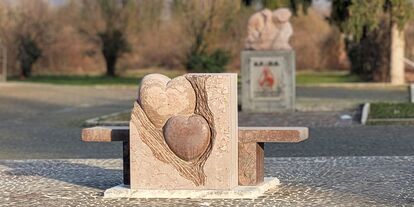
AmaTe is a bench-sculpture, intended to be lived before it is observed. It does not impose itself as a distant monument, but invites the simplest and most human gesture: sitting beside someone.
The seat is solid and welcoming. The backrest is formed by two hearts placed side by side, touching without fully merging. They are open, readable, immediately recognisable — a direct symbol of encounter, dialogue and relationship.
Those who sit are naturally encouraged to share the space, to look at one another, to talk. The work transforms love from an abstract concept into a concrete action.
Yet at the base of the bench, almost hidden from a distracted gaze, fractures appear. They are not decorative. They are wounds — cracks in the material that interrupt balance and introduce the theme of suffering, of the pain that arises when relationships break down, when love turns into control, oppression, violence.
That fracture reminds us that love is never harmless when respect is absent.
The message of AmaTe is therefore twofold and deliberately gentle:
- it invites love, sharing and dialogue;
- it does not erase pain, but makes it visible.
The title reinforces this interpretation: AmaTe is not only an appeal to others, but first and foremost to oneself. Loving oneself means recognising one’s value, knowing when to rise from a bench that hurts, choosing relationships that do not leave fractures.
In this balance between welcome and wound, AmaTe becomes a place of pause and reflection — a sculpture that does not shout, but speaks softly.