Valle
Parish Church of Saint John the Baptist
16th–17th Centuries
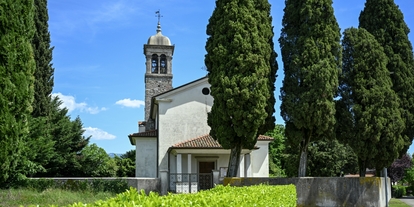
The small church, with a portico and a bell gable, is surrounded by the cemetery.
The earliest references to Valle and its church are found in the Necrologio di Qualso, of which Valle was a filial church, and date no earlier than the 14th century. From that period come notes mentioning the “cortina di Valle,” a defensive enclosure protecting the church and the few surrounding houses.
The ancient centa (fortified enclosure) was located around the Church of Saint John the Baptist, as suggested by the circular raised ground visible around the building in the Napoleonic cadastral map.
The original church had dimensions similar to the present one but was lower and featured pointed-arch windows, an atrium, and three altars: one dedicated to the Blessed Virgin and the other two, beside the choir, dedicated to the patron saints Saint Andrew the Apostle and Saint John the Baptist, whose statue is still preserved.
The church was restored in the early 16th century and further renovated and raised in height in the 18th century, when the original windows were replaced with the current ones.
Between 1798 and 1804 additional restoration works were carried out, and a new bell tower was built adjacent to the choir, in an elevated position within a stone-enclosed area. Some scholars believe the bell tower was erected on the remains of the ancient defensive tower of the centa.
After 1820, further works included the rebuilding of the sacristy and the removal of the two side altars, while their statues were relocated beside the high altar.
Inside, there are two side chapels rebuilt in 1922 with their respective niches and altars, created by Giorgio Cuzzi of Gemona.
The wooden statue of the Blessed Virgin of Health is by Rampogna, and that of Saint Louis is by the Val Gardena sculptor Delmez.
In 1771 the high altar was redesigned by Professor Francesco Valle, modernising the previous structure.
In 1923 a new tabernacle was crafted by the altar-maker Bortolo Rizzotti of Artegna, who also carved the single-piece stone of the high altar.
On the ceiling, a medallion features a fine fresco depicting the Beheading of Saint John the Baptist, echoing the style of G.B. Tiepolo seen in the Colleoni Chapel in Bergamo.
In the vault, at the four corners, are 17th-century medallions dedicated to the Doctors of the Church: Saint Gregory, Saint Jerome, Saint Ambrose and Saint Augustine.