Cortale
Parish Church of the Holy Name of Mary
14th–17th Centuries
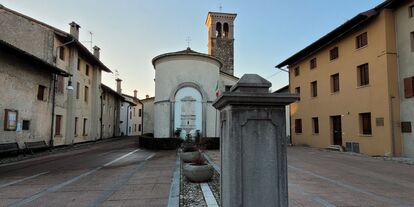
The church is first mentioned in 1360 in the Necrologio di Qualso, in a testament in which Francesco, son of Rambaldo of Vergnacco, his wife Margherita and his brother Benedetto left a quarter of wheat to the church of Santa Maria di Cortalo.
The present building retains its 18th-century layout, when the front portico was removed and the interior spaces were modified. Subsequent restoration and expansion works over the centuries have led to the appearance the church still maintains today.
The façade is simple, featuring a lintelled portal and two symmetrically arranged upper windows protected by iron grilles.
The bell tower was built between 1757 and 1764 and is partially incorporated into the northern side of the church. The shaft includes slit openings, while the square belfry has round-arched biforate windows and is topped by a four-pitched tiled roof. The crowning element consists of a double metal cross.
The interior surfaces are architecturally divided by pilasters and a moulded architrave from which the arches of the side chapels emerge. Larger round arches lead to the presbytery and the apse.
On the counter-façade stands the wooden choir loft supported by columns finished in marmorino.
In the semicircular apse, there is a war memorial monument.
On the ceiling, a late 18th-century painting by Carlo Boldi depicts the Annunciation.
L’interno presenta superfici architettonicamente divise da paraste e architrave modanata in cui si inseriscono gli arconi delle cappelle laterali e da cui si staccano i più imponenti archi a tutto sesto che immettono al presbiterio e all’abside.
Sulla controfacciata è impostata la cantoria in legno retta da colonne in marmorino.
Sull'abside semicircolare si trova il monumento ai caduti.
Sul soffitto si può ammirare un dipinto di Carlo Boldi della fine del Settecento che raffigura l’Annunciazione.