Remugnano
Sguardo alla luna (Gazing at the Moon)
by Maria Grazia Collini - Italy (Friuli Venezia Giulia)
1998
1st International Friuli Venezia Giulia Stone Sculpture Symposium
Pietra Piasentina
The Artwork
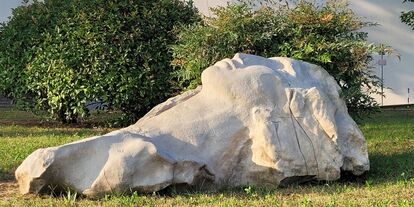
Sguardo alla luna (Gazing at the Moon)
Looking at the Moon is one of humanity’s oldest gestures, predating language, writing and history. It is the gesture of one who seeks meaning beyond oneself, but also of one who recognises being part of a greater rhythm.
In this work, the simplification of forms cancels the ego and personal identity, making space for something more universal: the human being who contemplates. The eyes are undefined, seemingly traversed by light, receptive. It is not the rational gaze of daylight, but the nocturnal, intuitive, lunar one.
The Moon evokes cyclical time (birth, growth, decline, return), the feminine principle, the unconscious, dreams — that which does not shine with its own light but reflects. To gaze at the Moon means recognising that we are not the source but the reflection, that our identity is not fixed but mutable. The sculpture seems to capture the moment in which the human being accepts this truth.
Pietra Piasentina introduces a powerful contrast: if the Moon is continuous change, stone is permanence. The artist perhaps suggests that the human desire for meaning and contact with mystery never changes, even as epochs, cultures and names do. The work appears as a figure caught in a silent ritual. There is no drama, no tension — only absolute calm, almost sacred. It is the moment when humanity stops speaking and listens to the sky. This sculpture becomes a mirror: rather than telling you something, it asks what kind of gaze you are using.
— Piera Sgiarovello
Critical Note
The title of this roughly hewn stone, simplified with both vigour and delicacy, recalls the magical aura of ancient Toltec sculptures of Tula, Mexico.
In this work, Collini demonstrates a remarkable ability to synthesise form conceived as monumental monolithic presence. The woman’s face is fully exposed to light, so that her gaze appears invaded and liquefied.
A suggestive work that evokes a metamorphosis within the mythical bond between femininity, lunar cycles and the fertility of the earth.
— Art Commission: Dora Bassi, Giacarlo Pauletto, Marco Marra, Ugo Carà
The Artist
Maria Grazia Collini
Maria Grazia Collini was born in Vergnacco (Udine). She began her artistic training by attending the three-year programme at the Giovanni da Udine Art School, later following drawing courses and seminars on the human figure. Between 1990 and 1991 she studied in the studio of the Friulian master Luciano Ceschia.
In 1983 she participated in founding the cultural association “Il Faro” in Vergnacco and since 1998 has collaborated in organising the International Friuli Venezia Giulia Stone Sculpture Symposium.
Since 1988 she has exhibited in solo and group shows and has participated in numerous competitions, receiving significant awards and recognition.
In the early 1990s she was invited to exhibit in Switzerland and Austria. In 1995 she took part in her first International Stone Sculpture Symposium in Sardinia, followed by many others in Italy and abroad.
Her works, including monumental sculptures, are held in public and private collections in Italy, France, Austria, Switzerland, Germany, South Korea (Icheon), the United Kingdom (Caerleon), India (Gwalior and Baroda), China (Shenzhen and Tonghe), Mexico (Tultepec), Iran (Mashhad), Cyprus (Ayia Napa), the United Arab Emirates (Abu Dhabi), Qatar (Doha), Morocco (Asilah) and Romania (Bucharest).